Home - Sewing and Crafts - Art - Gaming
Make do and Mend - Resource E-Zines - Free Sewing & Craft Patterns
So what is "Make do and Mend">

Image: IWM (Art.IWM PST 14733)
So what is this Make do and Mend thing anyway?
In short, Make do and Mend was a movement and campaign during World War 2 (1940-1949), in order to reduce consumption, and save resources that were needed for the war, in various countries. As I understand it, the initial campaign started in Britain, and because Canada is a commonwealth country, it was adapted here as well.
During the war the government had regulations for EVERYTHING to including how much water you could have for a bath, how much food you could get, how much gas and oil you could use for your car, and how much clothing or fabric you could have.
You still had to have money to purchase what you needed, but you also had to have government issued coupon booklets, that used a stamp system, to determine how much of one thing you could get for the week, month, or year. The tickets or coupons couldn't be traded or sold.
If you were caught selling anything over the price of what you bought a good or item for, you could receive hefty fines or even jail time
So what does that have to do with right now, almost a hundred years later?
I'm glad you asked, fellow denizen of the internet. In this day in age, we're seeing more and more the environmental impact, rising costs, and social implications of ultra fast fashion, high end fast fashion, and the extreme comodification of even buying used. Why this is happening? Wars, capitalism, and the enshittification of basic goods, products and services we need to live or stay sane.
Take a look at the world as it is right now in March 2026. War and the blocking of the Strait of Hormuz, is driving up the costs of oil, which is driving up the cost of gas, which is driving up the cost of shipping, let alone the whole flip flop on tariffs situation.
You know what else is a petrolium and oil by-product? That right. Polyester and other synthetic fabrics. What is our clothing mostly made of these days? That's right...Polyester and other synthetic fabrics.
The situation we're in is going to cause certain things to become scarce or expensive, such as clothing, or fabric to make clothing. Its going to get even more expensive with the rising costs of production. And trying to meet the 54 seasons a year in the fashion industry for companies to stay trendy, its just not sustainable and causes a lot of waste, let alone abhorent working conditions for those making the clothes in the first place, trying to make ends meet overseas.
Now think about where your clothes are made, and what countries the people who make them in. China is a big one, but other countries like Bangladesh, Taiwan, India, Turkey, Pakistan....see a pattern of where they're located? A lot of places are in central Asia, which is where a lot of these wars are taking place, or its a country bordering where the fighting is taking place, with the very real possibility that they may get dragged into the fighting. Even more disruption into the supply chain.
That also doesn't even start to cover where unsold clothing gets dumped, typically in Latin American countries, or African countries, such as Chile, Guatamala, Ghana, Kenya. Its so bad that piles of clothing can be seen from the moon in Chile according to the UN.
Ok you've got my attention, that's pretty bad. What can I do? I'm just one me!
There's a few things you can do as an individual, or as a group, or as an online movement or social collective.
1: Make do
Do you really need a fifth handbag? Do you really need that 10th pair of sneakers, or 6th pair of sun glasses, or 50 business ties? Probably not.
One of the best things you can do, not only for the environment but also for your pocket book, is to use what you have, and wear the same items as often as possible, and clean it with care so the fabric doesn't degrade from the wrong washing technique.
When it comes to wear, if your clothes don't smell like anything and aren't super soiled or dirty, re-wear it at least once more before washing it.
2: Mend your clothes
Patch bare spots before they become holes, patch holes before they become bigger holes. If your clothes don't fit, learn how to add in using color blocking or mix and match patterns from clothes to make whole new styles, or trim down clothes that you already own if you lost weight. Want a better fit but don't want to cut things out, add elastic or buttons or snaps. Add embroidery over stains to make something more artistic and unique to your personal style. The options are endless!
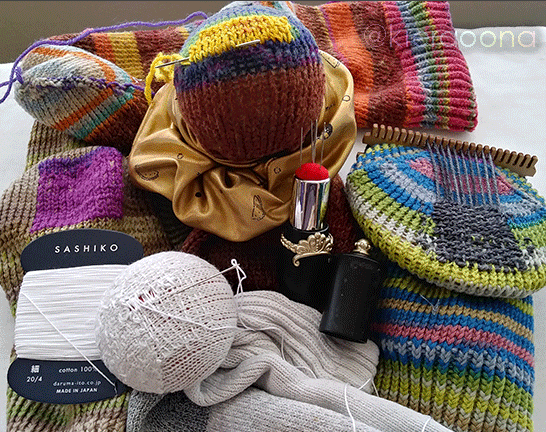
3: Use what you have on hand, and expand your skills. Learn from history, and remember mending and piecing has been done since the dawn of the invention of clothes
Got only thread, and a needle? do a small needle woven patch, got embroidery thread? Stitch a flower, robot, or meme. Got lace, stitch that down and make it cute. The only thing stopping you is how visible or invisible you want, your basic sewing skills level, and your creativity, all which can be taught
Know how to crochet, and some cotton yarn? Make a few rows to add in to upsize a piece. Know how to knit? Make a swatch and add it in! The possibilities are endless of what you can do with what you have available
Got one pair of socks where everything in the cuff is still good but the heels are totally blown, but a second pair that just needs a patch? Use the mostly dead pair of socks as a sacrifice to save the other pair. Patch it!
People of all genders, have been patching their clothes till its nothing but rags, or pieced pieces in if they need to make a pattern fit, ever since the invention of clothing. Fabric has always historically been expensive, and sewing machines are a rather new invention if you look at all of human history.
4: Join a mending event, to learn, to volunteer, or to trade
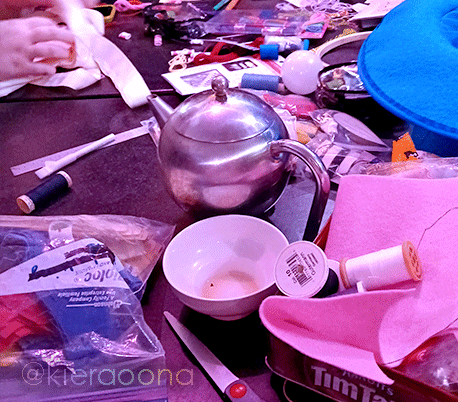
Look into your municipal events calendar as there are environmental groups looking to teach how to mend clothes if you don't know how to, to offer your services if you do know how to do mending to help or teach others, or trade clothes that dont fit, to refresh your wardrobe. A lot of these events are cheap or free, and could be a lifesaver for your wallet
5: Vote with your wallet
Don't buy from Shien, Temu, Zara, H&M, Alibaba, Amazon, Wish, Hot Topic, H&M, or any of the worst offenders for Ultra Fast Fashion. They're terrible to their employees, known for poor working conditions, slave wages, greenwashing (not as sustainable as they claim), human rights violations, or stealing from independant artists for their designs. If you're not sure, this site to Sustainibly Chic is a good list of companies, and why they're on the list of clothing companies to avoid if you can.
If you can, buy local. Especially from smaller businesses. Your money will go a lot further to help the local community than going into the pockets of a large corporation. Yes it will be a bit more expensive, but also likely a lot more durable and better made.
6: Build a capsule wardrobe
If you have a style that works with your day to day lifestyle, get core pieces that you can wear every day, that you can mix and match. If you stick to a simple palate, with 1-3 core colors (I suggest black, neutral grey or a brown and one more color), you can rotate your pieces so no matter what you pull out of your wardrobe, it all coordinates
7: Don't buy something and not wear it
Almost everyone is guilty of this, myself included. Buying something with the intention of wearing it, and never wearing it, it collects in your closet, then its no longer in style, or it doesn't fit. The best thing you can do is actually wear clothes you love, that are comfortable, and that you reach for frequently, and keep them in good condition with repairs and proper washing techniques according to the labels
Back to Make Do and Mend Main Page
Disclamer:
The information on this blog is presented in good faith, but no warranty is given, nor results guaranteed. Kiera-Oona's DIY and Kiera-Oona disclaims all liability from any injury to anyone undertaking the construction of any of the projects on this website as a result of improper safety precautions. Since we have no control over physical conditions surrounding the application of information herein contained, Kiera-Oona's DIY and Kiera-Oona disclaims any liability for untoward results.
Kiera-Oona does not use AI in any of her constructions or videos to the best of her knowledge, and does not use generative AI wherever possible. Just say no to Generative AI!